
Why Practice Matters More Than Knowledge in Sales
Le Anh Nguyen (Content Manager)
Ask a salesperson how to handle a price objection, and they might give you a perfectly sensible answer: understand the concern, establish value, then discuss the options.
Put them in front of a buyer who says, “Your competitor is 20% cheaper,” and they might offer a discount before asking a single question.
They knew the approach. Using it in that moment was harder.
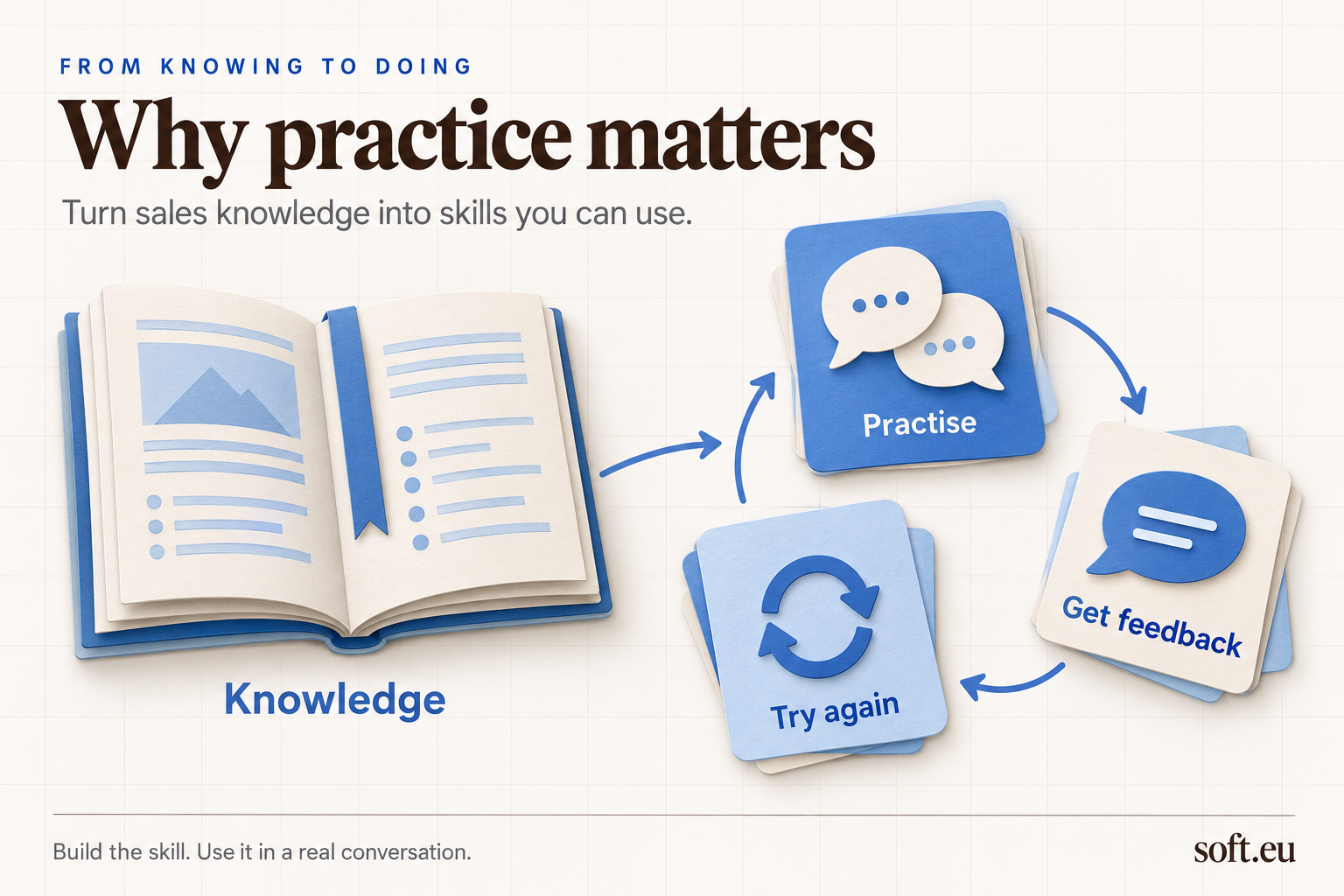
Practice matters because it develops the ability to use knowledge when the situation demands it. In sales, that means listening, choosing a response and delivering it while someone else is steering the conversation. Reading a framework gives you a starting point. Rehearsing helps you find out whether you can actually use it.
TL;DR
Knowledge gives salespeople the facts and methods they need. Practice helps them apply those methods in a conversation.
Effective sales practice involves a specific skill, useful feedback and another attempt. Repeating the same pitch without adjusting it has limited value.
Research on memory and sales training supports retrieving information and spreading practice over time.
AI roleplay makes rehearsal easier to access. Progress still needs to show up in real customer conversations.
Why doesn’t knowing the answer guarantee you can use it?
A training exercise on paper usually tells you which problem you’re solving.
A section titled “Handling price objections” makes the task obvious. You read the buyer’s statement, consider the available responses and choose one.
Customers don’t label their concerns so neatly.
“This seems expensive” might mean the buyer has a strict budget. It might mean they haven’t understood the value. They might be comparing your full implementation package with a competitor’s licence fee. Or they might simply be negotiating.
The salesperson has to work out which conversation they’re having before choosing a response.
That requires more than remembering a technique. It requires noticing a cue, asking a useful question and paying attention to the answer—even when there’s pressure to keep the deal moving.
Consider SPIN Selling. Learning the four question types is straightforward. Recognising that a buyer has just described a problem worth exploring, then asking about its consequences without sounding rehearsed, takes more work.
Practice gives you somewhere to do that work before the outcome affects a customer relationship.
Familiarity can make you feel more prepared than you are
Reading a good sales script is reassuring. The opening makes sense. The questions sound natural. You can picture yourself saying the words.
Then you close the document and try.
You stumble over the opening. You forget the question you liked. When the other person answers unexpectedly, you lose your place.
There’s a useful research finding behind this gap.
In a 2006 study, psychologists Henry Roediger and Jeffrey Karpicke asked students to learn short passages. In one experiment, students who studied once and then practised recalling the material three times remembered 61% of the ideas a week later, compared with 40% among students who studied the passage four times. Yet the repeated-study group had been more confident about how much they would remember. Roediger and Karpicke, Test-Enhanced Learning
The experiment measured memory for written material, so those percentages aren’t a forecast for sales performance. But it illustrates something relevant to training: material can feel familiar without being easy to retrieve later.
For a salesperson, a simple way to expose that gap is to close the playbook and explain a product’s value to someone playing a particular buyer. Where do you hesitate? Which claims can you support? What happens when they interrupt?
Those moments tell you what to work on next.
What does effective sales practice actually look like?
Imagine a rep selling software to an operations director. During a rehearsal, the buyer says:
“We like the platform, but your competitor is about 20% cheaper.”
The rep responds:
“I understand. We may have some flexibility if you can sign this month.”
The conversation has moved to discounting before the rep understands the comparison.
A broad comment such as “You need to sell the value more” won’t give them much to work with. Useful feedback points to the specific decision:
“You offered a concession before finding out what the competing quote included. Replay that moment and clarify the comparison first.”
On the next attempt, the rep tries:
“What’s included in their quote? I want to make sure we’re comparing the same scope.”
The buyer explains that implementation and support cost extra. Now the rep has something concrete to discuss.
In another version, the buyer confirms that the packages are comparable and the price difference is real. The rep needs to explore priorities, scope or commercial options.
Both versions are worth practising. Otherwise, the exercise can teach the rep to expect a convenient answer every time.
This is where a library of sales objections becomes useful: take an objection, give the buyer a credible reason for raising it, and rehearse the conversation that follows.
Work on a behaviour you can observe
“Get better at discovery” is too broad for one practice session.
A more useful objective would be:
When a buyer describes a problem, ask a follow-up question about its consequences before introducing a product feature.
You can hear whether that happened. You can also assess whether the question followed naturally from what the buyer said.
The same principle applies elsewhere. A rep might practise summarising a concern before answering it, explaining a technical feature without jargon, or agreeing a next step with a named person and date.
Small objectives make feedback easier to use.
Give the rep another attempt
A debrief can produce plenty of agreement without changing the behaviour.
“Yes, I rushed that.”
“Yes, I should have asked another question.”
The next attempt is where the rep has to turn that observation into a different response. Leave time for it. Replaying two minutes of a conversation can be more useful than adding another ten minutes of advice.
Change the circumstances
Once a rep handles the first version comfortably, change something.
The buyer might be in a hurry. They might answer vaguely. A second stakeholder might disagree about what matters.
These variations help you see whether the rep understands the purpose of the approach and can adapt it. You’re looking for sound judgement across different conversations, rather than one polished performance.
Why should practice continue after the training session?
A workshop gives everyone time to focus. The difficulty is what happens when they return to work.
A rep may understand a new approach on Friday, then spend Monday dealing with overdue proposals and familiar customer requests. Unless there’s another opportunity to use the approach, the training can remain separate from the job.
Research has examined this question in a sales setting.
A 2010 study by Simone Kauffeld and Nale Lehmann-Willenbrock compared spaced and concentrated sales training among 64 bank employees. The group whose training was spread out showed better quality of training transfer—the application of learning at work—and higher self-reported sales competence. They did not outperform the other group on every measure: the quantity of transfer did not increase. Kauffeld and Lehmann-Willenbrock, Sales Training: Effects of Spaced Practice on Training Transfer
It was a small, quasi-experimental study. It nevertheless provides a practical reason to plan follow-up practice instead of expecting a single intensive session to carry all the learning.
For a sales team, that could mean introducing a technique in a workshop, rehearsing it later that week, then returning to it after reps have encountered it with customers.
The later session has a different starting point. People can bring questions such as, “What should I do when the buyer won’t share a number?” or “How do I ask about the decision process without sounding pushy?”
Those questions make the next round of practice more relevant.
Isn’t making real sales calls already practice?
Real calls provide experience. They also provide material for coaching. But they don’t always make it easy to improve a particular skill.
Suppose a rep offers a discount and wins the deal. Did the discount make the difference? Would the buyer have signed anyway? Did the rep miss an opportunity to adjust the scope instead?
The result alone won’t answer those questions.
On a customer call, you also can’t pause, ask for feedback and replay the last exchange. In a rehearsal, you can isolate the decision and compare different responses.
A useful routine connects the two:
Bring a difficult moment from a real conversation into training.
Rehearse another way to handle it.
Look for the behaviour in subsequent calls.
For example, if a rep often leaves meetings with “I’ll send you something,” practise agreeing what the buyer needs to review and when you’ll discuss it. Then check whether their next few calls end with clearer commitments.
That gives practice a specific job to do.
How can managers tell whether practice is working?
Attendance and completed exercises tell you whether people participated. To assess improvement, listen for the behaviour you wanted to change.
If the objective was to explore objections before responding, review whether the rep asked a relevant question and used the answer. Counting questions alone won’t tell you much.
You can assess progress at three points:
During rehearsal: Can the rep use the skill after feedback?
In a different scenario: Can they adapt it when the buyer’s concern or circumstances change?
On customer calls: Does the behaviour appear without someone prompting them?
Commercial outcomes matter too, but they take longer to interpret. Deal quality, pricing, territory and buying conditions all affect results. A better rehearsal score is encouraging; evidence that the rep handles the same situation more effectively with customers is more useful.
Where does AI roleplay help?
One practical obstacle to regular sales practice is scheduling. A rep has ten minutes available, but their manager is in a meeting. A colleague is willing to help, but they’re preparing for a call of their own.
AI sales roleplay gives the rep another way to rehearse during that window. They can work through a scenario, review feedback and try again.
Its value depends on the exercise. A prospect who agrees with everything won’t offer much challenge. Feedback that praises every answer won’t help someone decide what to change.
Look for scenarios that reflect the conversations your team actually has, with feedback tied to observable behaviour. Keep managers involved in judging whether the suggested approach fits the product, customer and commercial context.
The balance between AI and human sales roleplay can vary by need. AI can make frequent rehearsal easier to organise; a colleague or manager can help unpack a sensitive negotiation or a complicated account relationship.
Turn knowledge into practice with Soft
With Soft, salespeople can rehearse conversations with AI prospects, get feedback and work on specific skills through targeted exercises.
Choose a moment you want to handle better—a vague discovery answer, a price objection or a rushed opening—and practise it before your next customer call.
Try Soft for free and put your sales knowledge into practice.
FAQ
Why is practice more important than knowledge in sales?
Once a salesperson understands the product and the basic approach, practice helps them use that knowledge in live conversations. It gives them opportunities to choose responses, receive feedback and adapt to different buyers. Product knowledge remains essential for giving accurate, useful advice.
What is the difference between sales knowledge and sales skills?
Sales knowledge includes information about your product, customers and sales methods. Sales skills are the actions you can perform with that information: asking useful questions, explaining value, handling objections and negotiating. Someone can explain a technique clearly while still needing practice to use it.
How often should salespeople practise?
Build recurring sessions around the skills they need for upcoming conversations. Start with a schedule the team can sustain, revisit skills over time and adjust based on what you hear in calls. There’s no single practice frequency that suits every salesperson or sales cycle.
Can practising the same pitch improve sales performance?
It can help a rep become more comfortable delivering it, but sales conversations require adaptation. Vary the buyer, their priorities and their responses. Include feedback and opportunities to revise the approach so that repetition leads to improvement.
How does AI support sales practice?
AI roleplay lets salespeople rehearse simulated customer conversations without coordinating with a partner each time. It can provide feedback and opportunities to retry. Managers can then assess whether those improvements carry over into real customer interactions.