
Forgetting Curve: Why Training Fades and How AI Can Help
Le Anh Nguyen (Content Manager)
On Friday, your team finishes a workshop on handling sales objections. Participants understand the method, complete the exercises and leave with more structured responses.
Three weeks later, a prospect challenges the price. The salesperson immediately offers a discount without exploring the concern.
This scenario illustrates a practical problem: performing well during training doesn’t guarantee that someone will apply the same skills several weeks later.
The forgetting curve helps explain part of that gap. But it has also inspired some questionable shortcuts, including the claim that “70% of skills learned in training are forgotten within 30 days.”
What does the research actually show? How can organisations reinforce learning after a course? And under what conditions can artificial intelligence help employees develop lasting skills?
TL;DR
“70% of skills are forgotten within 30 days” is not a universal scientific finding. Memory research doesn’t support applying that figure to every training programme.
Immediate performance and lasting learning are different outcomes. An assessment at the end of a workshop cannot tell you what employees will remember a month later.
Active recall and spaced practice have strong research support. They involve retrieving and using knowledge repeatedly over time.
AI can make frequent, varied and personalised practice more accessible. Its value depends on how the learning activities are designed.
An AI assistant that always supplies the answer can reduce the effort required to learn. Assess what employees can do without assistance, too.
Measure retention and workplace application. Course completion and simulation counts alone don’t demonstrate competence.
What is the forgetting curve?
The forgetting curve describes how retention changes over time after learning. In classic experiments, the decline is initially steep and then slows.
The concept is associated with Hermann Ebbinghaus, who studied his own ability to remember lists of meaningless syllables.
One detail matters: he measured savings in relearning, meaning the effort saved when learning previously studied material again.
In 2015, Jaap Murre and Joeri Dros published a replication of this approach. One participant spent approximately 70 hours learning and relearning lists, with delays ranging from 20 minutes to 31 days. The results followed a pattern similar to the historical findings. Source: Murre and Dros, PLOS ONE, 2015.
These studies examine memory under specific conditions. They don’t directly measure a salesperson’s ability to negotiate, a manager’s ability to deliver feedback or an adviser’s ability to handle a complaint.
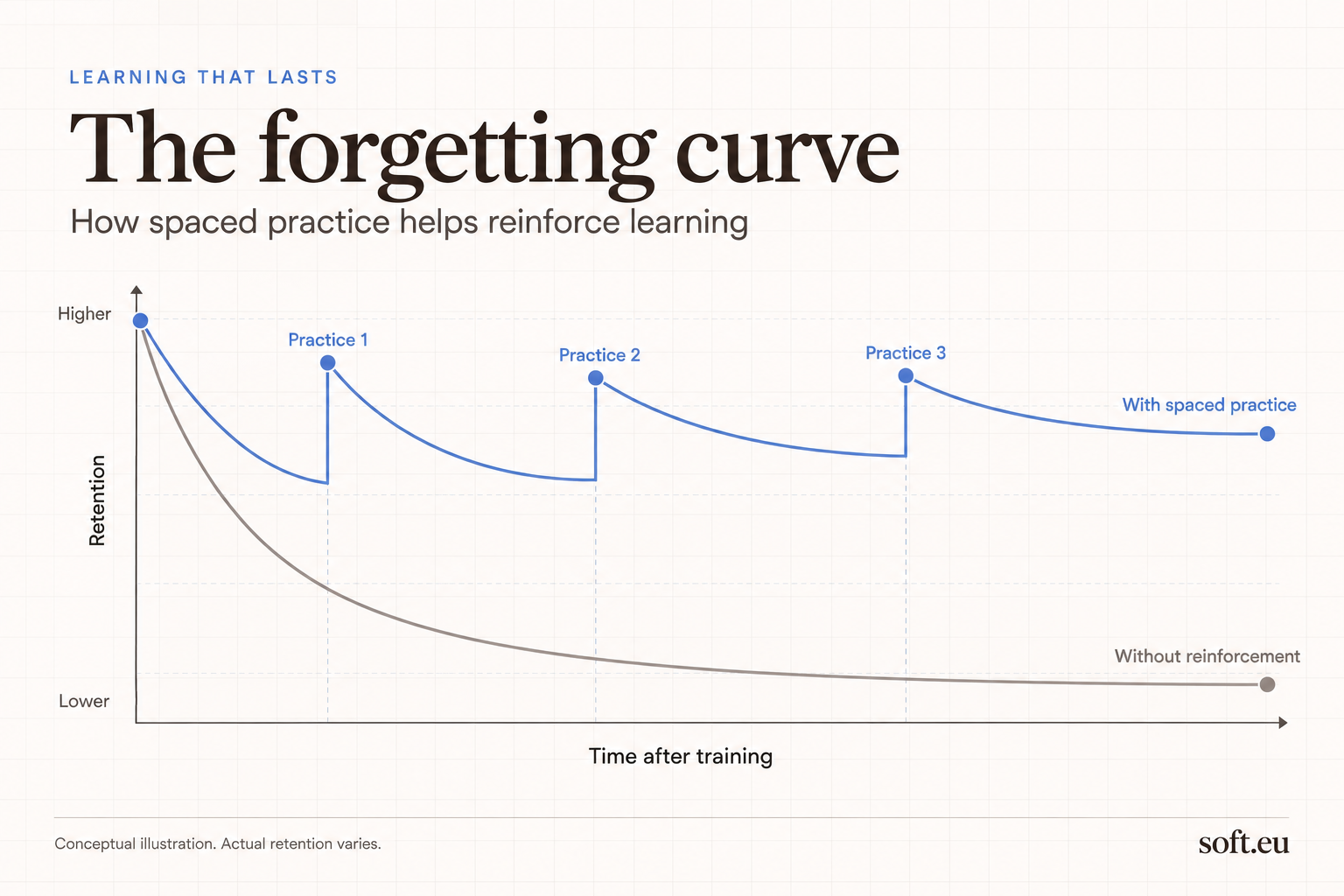
Do employees really forget 70% of their skills within 30 days?
The research cited here does not establish that employees universally lose 70% of the skills acquired in training within 30 days.
That percentage should therefore not become an automatic estimate of your organisation’s training losses.
To interpret a forgetting rate, you need to know what participants learned, how they learned it and what the assessment measured: recognising an answer, recalling information, relearning faster or performing a task.
The distinction matters in the workplace.
A salesperson might forget the name of a framework while continuing to ask effective questions. Another might recite its four steps but struggle to use them with an impatient buyer.
A more useful question for a training programme is:
“What can our employees still do several weeks later, in a situation they haven’t rehearsed word for word?”
That question directs you towards measuring your own outcomes, rather than applying a general percentage to your training budget.
Why can well-understood training be difficult to apply?
Memory doesn’t explain every gap between training and subsequent behaviour. Several difficulties can overlap.
Employees recognise the content but struggle to retrieve it independently
During training, slides, examples and the facilitator’s questions provide cues. These can help participants produce a good answer.
In a customer conversation, those cues disappear. The salesperson must recognise the situation, retrieve a suitable approach and formulate a response within seconds.
To identify this gap, ask employees to handle a scenario without supporting material before showing them a suggested response.
The first opportunity to practise comes too late
Negotiation training might take place several weeks before the next important negotiation. In between, the employee may have no opportunity to use the approach.
Schedule intermediate exercises around specific moments: clarifying a discount request, responding to a competitor comparison or explaining a proposed trade-off.
Each exercise should require a concrete action.
Practice prepares employees for only one scenario
Someone might perform well with a cooperative buyer and struggle with one who interrupts or challenges their assumptions.
To assess adaptability, change the details that affect the appropriate response: the customer’s priorities, existing knowledge, decision-making authority or underlying concern.
The workplace discourages the behaviour being taught
A salesperson may understand the importance of exploring a customer’s needs while being assessed almost entirely on call volume.
More practice won’t resolve that tension on its own. Managers also need to examine expectations, available tools and the time allocated to the desired behaviour.
Before diagnosing a memory problem, check whether employees have a realistic opportunity to apply what they learned.
Which methods help people retain what they learn?
Learning research supports two approaches in particular: active recall and spaced practice. They can inform the design of professional training exercises, provided their impact is also assessed in the workplace.
Active recall: retrieve an answer before reviewing it
Active recall means attempting to retrieve information from memory. It can involve answering an open question, explaining something without notes or solving a problem.
In a study published in 2006, Roediger and Karpicke compared different ways of learning passages of text. After one week, participants who completed one study period followed by three recall tests remembered 61% of the ideas, compared with 40% among those who spent all four periods studying.
That is a difference of 21 percentage points on a text-recall task. It is not a measured improvement in sales performance. Source: Roediger and Karpicke, Psychological Science, 2006.
For a sales team, one practical application could be:
“The prospect says our competitor is cheaper. What would you ask before explaining our differences?”
The employee produces a response and then receives feedback. The exercise also reveals what they can retrieve independently.
Spaced practice: revisit a skill at different points in time
Spaced practice distributes learning opportunities over time.
A meta-analysis by Cepeda and colleagues examined 317 experiments, covering 839 assessments of distributed practice. Among its findings, the most effective spacing depended on how long learners needed to retain the material: an interval suited to a near-term test wasn’t necessarily appropriate for a more distant assessment. Source: Cepeda et al., Psychological Bulletin, 2006.
There is therefore no single schedule that should be applied mechanically to every skill.
You can start with several practice sessions spread across a month, then adjust their frequency according to observed difficulties and opportunities for real-world use.
Variation: apply the same principle in different situations
Professional skills need to work across contexts.
A study published in PNAS in 2024 examined vocabulary learning across six experiments and lecture material in a seventh. Varying the cues used during retrieval improved learning in the conditions studied, particularly when retrieval attempts were spaced. Source: Butowska-Buczyńska et al., PNAS, 2024.
For sales training, this suggests an approach worth testing: keep the target skill consistent while changing the situation.
An exercise on common objections could involve a fixed budget ceiling, a cheaper competing offer and uncertainty about ROI. The opening phrase might be similar, but an effective response should change with the underlying concern.
How can AI reinforce learning after training?
AI’s contribution depends on the activities it enables: answering, explaining, deciding, receiving feedback and trying again.
For a team spread across multiple locations, organising these opportunities can be difficult. AI can help provide more individual practice between formal training and coaching sessions.
Turn training content into a conversation employees must conduct
A presentation describes a discovery method. A simulation asks the salesperson to apply it.
Consider this illustrative scenario:
Prospect: “We already have a provider, and we’re not looking to change.”
The salesperson must choose a question, listen to the response and decide whether the opportunity warrants further exploration.
AI can play different buyers and continue the conversation in response to the salesperson’s choices. For the exercise to be useful, the scenario needs a defined context, customer objectives and accurate boundaries around the offer.
Focus feedback on a specific behaviour
An overall score doesn’t always explain what someone should improve.
Useful feedback might say:
“You offered a discount before asking what the customer was comparing. Restart from the objection and establish their reference point first.”
The employee can replay that moment and then face a different version of the problem.
The learning opportunity comes from the sequence: an attempt, precise feedback, a correction and another application.
Adjust the challenge to observed performance
Two salespeople might achieve the same quiz score while struggling with different parts of a conversation.
One asks useful questions but gives lengthy answers. The other explains value clearly but overlooks the decision process.
An AI-supported programme can suggest different exercises based on those observations. However, the assessments need checking: an unusual response may be appropriate, while a fluent answer may contain an error.
Managers can review a sample of simulations to compare the tool’s feedback with the organisation’s criteria.
Create more practice opportunities between coaching sessions
Imagine 40 salespeople each completing three eight-minute simulations. That represents 16 hours of practice across the team.
This illustrates practice volume, not an automatic saving of 16 management hours. Someone still needs to prepare scenarios, examine recurring difficulties and coach complex cases.
AI can make the practice more accessible. Managers remain essential for connecting it with customer expectations and situations employees encounter at work. Our guide to combining AI role-play with human coaching explains how to organise that balance through diagnosis, targeted practice, manager feedback and validation.
Is there evidence that AI improves learning?
There are encouraging findings, but they don’t justify a universal promise of lasting retention.
A randomised study published in Scientific Reports in 2025 involved 194 undergraduate physics students at Harvard. Researchers compared an AI tutor designed around specific pedagogical principles with an active-learning classroom.
Students using the tutor made greater gains on the study’s assessments while spending less time on the material. The finding concerns that system and setting; it does not, by itself, demonstrate retention of sales skills after 30 days. Source: Kestin et al., Scientific Reports, 2025.
Other research shows why design matters.
In an experiment involving nearly 1,000 high-school mathematics students, an AI assistant with limited learning safeguards improved performance during assisted exercises. But once access was removed, students’ grades were 17% lower than those of the control group. A version designed to guide students rather than provide solutions largely eliminated this negative effect, without producing a significant improvement on the independent exam. Source: Bastani et al., PNAS, 2025.
These studies highlight two distinct objectives: completing a task with a tool and learning to perform it independently. A training programme should specify which outcome it intends to develop.
How can you use AI without removing the effort required to learn?
Give employees an opportunity to produce their own response first.
If they get stuck, provide progressive assistance: a question, a hint or a partial reminder. A complete answer can then help explain the gap, provided the employee also gets another opportunity to try.
For a price objection, the coach might ask:
“What information are you missing that would explain why the customer considers the price too high?”
The salesperson still needs to think and formulate a question.
Include assessments without real-time suggestions. In a sales simulation, AI can continue playing the prospect while withholding coaching prompts during the assessment of independent performance.
Finally, ground scenarios and feedback in approved information: product capabilities, commercial terms, quality criteria and limitations. A simulation that rewards an impossible promise reinforces the wrong behaviour.
What could a 30-day reinforcement programme look like?
The following example is designed for a team trained in objection handling. It provides a starting point to adapt, rather than a universally optimal schedule.
Timing | Activity | Purpose |
|---|---|---|
Day 0 | An unsupported scenario at the end of training | Establish what the participant can already apply |
Day 2 | A recall question and short simulation | Reactivate the approach and address an initial gap |
Day 7 | A new objection in a different context | Assess adaptation to a less familiar situation |
Day 14 | Targeted simulation and manager debrief | Work on a persistent difficulty |
Day 30 | An unfamiliar scenario without assistance, followed by feedback | Assess learning retained over time |
The programme should evolve with performance.
If someone doesn’t understand the reasoning on day two, they need an explanation and guided practice. If they handle several variations successfully, introduce a more complex case or increase the interval before the next session.
Managers can also connect exercises with upcoming meetings:
“Your next conversation involves procurement and finance. Let’s practise a price objection from each stakeholder.”
Continue beyond day 30 where needed. Rarely used skills and new product launches may warrant further practice.
How do you measure what employees retain after training?
Distinguish three levels when evaluating a programme.
1. Knowledge employees can still retrieve
Ask employees to explain an approach or identify the information they need without consulting the training material.
This shows what they can retrieve from memory. It doesn’t establish their ability to manage an entire conversation.
2. Skills demonstrated in a scenario
Use an unfamiliar scenario with a difficulty level comparable to the initial assessment.
For objection handling, the criteria might include:
Clarifying the concern before responding.
Using accurate information.
Adapting the response to the context.
Checking what remains unresolved.
Proposing an appropriate next step.
Keep the criteria consistent and examine specific behaviours. An increase in the overall score can conceal an important weakness.
3. Application in everyday work
Look for evidence in observed meetings, debriefs or relevant workplace interactions.
Does the salesperson ask more useful questions before offering a discount? Do they identify the people involved in the decision more accurately?
Commercial results can complement this assessment, but they also depend on opportunity quality, market conditions and the terms of the offer.
To test the programme’s contribution, compare similar groups where practical. Give them the same initial training, with or without the reinforcement programme. Measure their starting performance and assess them at comparable intervals.
What mistakes should you avoid when reinforcing training?
Sending content reminders without an activity. An email can encourage employees to revisit a topic. Add a question or exercise to establish what they can actually use.
Confusing short content with active learning. A three-minute video is still a viewing activity. Its length doesn’t guarantee that someone practises a skill.
Repeating the same scenario every time. You may end up measuring recall of the exercise. Change the details that require a different judgement or response.
Relying entirely on satisfaction scores. A positive experience can support engagement, but it doesn’t establish what employees retain several weeks later.
Turning every practice session into a ranking. Preserve opportunities to experiment, make mistakes and try again. Developmental exercises and formal assessments serve different purposes.
Attributing every improvement to AI. Additional practice time, coaching and scenario quality are all part of the programme. Their contributions also matter.
How can Soft fit into a sales training programme?
Soft provides sales simulations with AI buyers, personalised feedback and targeted exercises based on identified difficulties.
These capabilities can support a reinforcement programme built around your training: initial instruction, practice distributed over time, debriefs and delayed assessment.
Start with an observable skill. For example: clarifying a price objection before presenting an argument.
Prepare several representative situations, define what an effective response should accomplish and assess the same skill again after several weeks. This gives you a concrete indication of what participants can still do.
Try a simulation with Soft to follow your next training session with practical application.
FAQ: The forgetting curve, training and AI
What is the forgetting curve in employee training?
The forgetting curve describes how retention of information declines over time. In workplace training, it supports the case for revisiting learning and assessing employees after a delay. It cannot predict one universal rate of loss across all skills.
Do employees forget 70% of training within 30 days?
That figure is not an established general rule for workplace training. Outcomes depend on what employees learn, how they practise and how retention is measured. Assess your teams over time to understand their actual results.
What is the difference between active recall and spaced repetition?
Active recall involves retrieving information or an approach before consulting the answer. Spaced repetition distributes learning sessions over time. They can be combined by scheduling recall exercises at several intervals.
How often should employees practise after training?
There is no universal frequency. Sessions after a few days and across subsequent weeks can provide a starting point. Adjust the schedule according to difficulty, observed performance and opportunities to apply the skill at work.
Can AI prevent forgetting?
AI can make regular practice, varied scenarios and personalised feedback more accessible. It cannot guarantee retention. Evaluate its contribution over time, including through tasks completed without assistance.
How can you tell whether training has produced lasting skills?
Compare immediate and delayed performance on different but comparable tasks. Then examine application in everyday work. Completion rates and end-of-course scores provide useful information, but they are insufficient on their own.