
Active Listening Training: 7 Practical Exercises for Customer Service Advisors
Le Anh Nguyen - Content Manager
Active listening does not fail because customer advisors do not know the technique. It fails because, under time pressure, old call-handling reflexes take over: solve quickly, follow the script, move to the next call.
The answer is not another workshop. It is short, repeated, observable practice built into the working week.
This matters particularly for service organisations asking inbound teams to make more outbound calls: renewal checks, post-claim follow-ups and coverage reviews. When the advisor opens the call with an agenda of their own, listening becomes harder. The customer must still feel that their situation—not the checklist—is driving the conversation.
This guide is for customer service leaders, sales leaders and training managers. It explains the behaviours to train, seven exercises that make them practisable, a 90-day reinforcement plan and a measurement approach that is credible with operations leaders.
TL;DR
Active listening rarely fails because advisors do not know the technique. It fails because pressure brings back old call-handling reflexes.
Paraphrasing is useful, but it works best when it opens the conversation: reformulate, then invite the customer to add or correct something.
The customer experience cost of making people repeat themselves is high. A clear summary and usable handover reduce that effort.
Classroom learning needs reinforcement. Short, spaced practice is a well-supported way to improve long-term retention, although the best schedule will depend on the job and the team.
Seven drills—echo and label, the no-advice opening, repeat-proof summary, question funnel, three-second pause, outbound listening and de-escalation—turn listening into an observable habit.
Measure behaviour alongside business outcomes. Do not attribute repeat contacts or satisfaction scores to listening alone without allowing for case complexity, process failures and staffing.
What does active listening means on a service call ?
Active listening is the visible work of checking that you have understood a customer before moving to a solution. It combines attention, reformulation, curiosity and a clear closing summary. The idea is commonly associated with Carl Rogers and Richard Farson’s work on listening for both content and feeling.
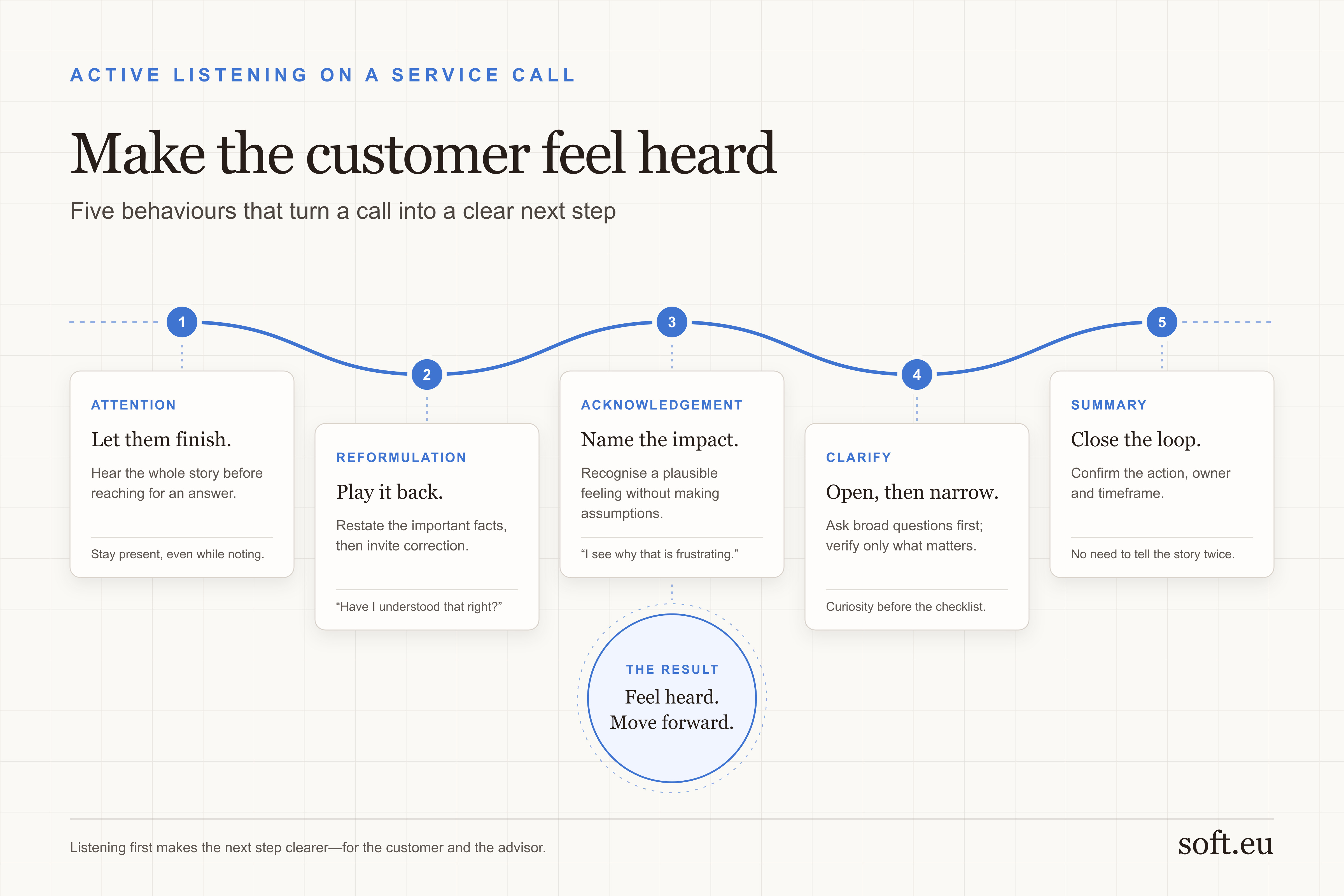
On a service call, look for five observable behaviours:
1. Attention. Let the customer finish. Do not prepare a stock answer while they are still explaining. When case notes must be taken during the call, signpost that you are doing so and keep the customer engaged.
2. Reformulation. Restate the relevant facts in your own words, then check: “Have I understood that correctly?”
3. Emotional acknowledgement. Name a plausible feeling without pretending to know more than the customer has said: “After two postponed visits, I can see why that is frustrating.”
4. Clarifying questions. Begin broad enough for the customer’s account to emerge; narrow only when the facts, safety or compliance process require it.
5. Summary and next step. Before the call ends or transfers, say what has been understood, what will happen next and when the customer can expect it.
What the research supports—and what it does not
The evidence gives useful direction, but it should not be oversold.
In a 2010 peer-interview experiment, Harry Weger and colleagues found that paraphrasing made the listener seem more socially attractive, but on its own did not make participants feel more understood. In their 2014 follow-up, 115 participants who received active-listening responses—paraphrasing combined with questions that invited elaboration—felt more understood than those who received advice or simple acknowledgements. These were short initial interactions with university participants, not high-stakes customer-service calls. Still, the practical lesson travels well: “If I understand correctly…” should open the conversation, not close it.
The business case is equally practical. In its research on more than 75,000 customer-service interactions, CEB found that reducing customer effort was a stronger route to loyalty than trying to delight customers. Having to repeat information is a classic source of effort. Listening therefore includes a process responsibility: capture the story accurately enough that the customer does not have to tell it again.
Training-transfer research points to the same operational problem. In a survey of training professionals from 150 organisations, Saks and Belcourt reported that 62% of employees applied training immediately, 44% after six months and 34% after one year. The figures are self-reported organisational estimates, so they do not prove that every course follows the same curve. They do show why reinforcement after training deserves as much design attention as the course itself.
Spaced practice is a well-supported way to improve long-term retention. Cepeda and colleagues’ synthesis of 317 experiments was conducted largely with verbal-recall tasks, so it does not prescribe a universal schedule for phone skills. It does support the underlying design choice: distribute practice rather than trying to install a habit in one intensive block.
The 7 active listining exercises for Customer Service Advisors
Each drill takes 5–15 minutes. Use an anonymised version of a real call type (claims, billing, account closure or delivery failure) rather than a generic “angry customer” script.
Exercise | Behaviour trained | Time | What to score |
|---|---|---|---|
Echo and label | Reformulation and emotional acknowledgement | 10 min | Facts restated, feeling acknowledged, check question asked |
No-advice opening | Holding back premature solutions | 10 min | Solution statements before the agreed listening window |
Repeat-proof summary | Summary and handover | 5 min | Whether another advisor can continue without re-asking |
Question funnel | Open-to-specific questioning | 10 min | Quality and sequence of questions |
Three-second pause | Attention and non-interruption | 5 min | Interruptions; useful information volunteered after a pause |
Outbound listening | Listening when the advisor placed the call | 15 min | Relevant signals noticed, acknowledged and recorded |
De-escalation loop | Emotion before explanation where appropriate | 15 min | Acknowledgement before defence; a clear, dated next step |
1. Echo and label
Goal: Reformulate the facts and acknowledge the customer’s experience before proposing a solution.
How it runs: Play a 60-second customer statement. The advisor has two sentences to restate the facts, one sentence to acknowledge the impact, and one question to check or invite correction.
Example: A customer says water damage from the upstairs flat has ruined her kitchen ceiling, the expert visit has been postponed twice and guests are due next week.
“The damage came from the flat above, the expert visit has moved twice, and you need the kitchen usable before next week. After those delays, I understand why this feels exhausting. Is there anything important I have missed?”
Score: Did the advisor include the source, delay and deadline? Did they acknowledge an emotion without exaggerating it? Did they ask a genuine check question? No solution is needed yet.
2. The no-advice opening
Goal: Break the reflex to solve before the problem is understood.
How it runs: For the opening 60–90 seconds of a simulated call, the advisor may ask, reformulate or acknowledge—but may not recommend a solution. Agree the window in advance; shorten or remove it for safety, fraud, safeguarding or urgent operational calls.
Score: Count solution statements made before the window closes and count useful open questions. The aim is not silence for its own sake; it is enough understanding to offer the right next step.
3. The repeat-proof summary
Goal: Prevent the customer from having to retell their story.
How it runs: At the end of a simulated call, the advisor gives a 20-second spoken summary: situation, action, owner and timing. They then write a three-line handover note. A colleague must be able to continue the case without asking the customer for information already supplied.
Score: Does the summary state a next step and timeframe? Does the handover contain the customer’s situation, relevant constraints and agreed action? Mark any unnecessary re-ask.
4. The question funnel
Goal: Let the customer’s account emerge before verifying details.
How it runs: The advisor practises three question types on one case:
Open: “Can you tell me what happened?”
Probing: “What worries you most about the repairs?”
Specific: “Was anyone at home when the leak started?”
Score: Assess sequence and quality, not a rigid quota. An opening question should usually be open, while specific questions are appropriate for eligibility, compliance and factual verification. Flag closed questions that merely confirm the advisor’s untested assumption.
5. The three-second pause
Goal: Stop finishing the customer’s sentence or mistaking a pause for the end of their story.
How it runs: After the customer stops speaking, the advisor silently counts to three before responding. In the simulation, give the customer one optional extra detail to offer during that pause.
Score: Interruptions per call, plus useful information volunteered after a pause. In a live call, the advisor can make the pause audible through a brief acknowledgement such as “I’m just making sure I’ve captured that.”
6. The outbound listening drill
Goal: Keep listening when the organisation, rather than the customer, initiated the conversation.
How it runs: The advisor calls about a routine matter—a post-claim follow-up or annual review. The simulated customer mentions two or three relevant life signals, such as moving home, a new car or a child leaving for university. The advisor states the purpose in one sentence, asks one open question and listens rather than rushing into the checklist.
“I’m calling to check that everything was settled properly after your claim in March. Before anything else, how have things been since?”
Score: Count relevant signals noticed, acknowledged and recorded. Do not reward an immediate sales pitch; the first task is to understand whether the signal matters to the customer.
7. The de-escalation loop
Goal: Address the customer’s experience before defending or explaining a decision.
How it runs: Use a case involving a partial reimbursement or a delayed repair. The advisor follows four steps: acknowledge the impact, reformulate the concern, explain the decision in plain language, and give a concrete next step.
Score: Was the emotion acknowledged before the explanation? Were defensive phrases avoided—“It’s company policy” or “As I already said”? Is there a clear next action and date? Where safety, legal disclosure or fraud controls come first, adapt the sequence rather than forcing it.
A 90-day reinforcement plan
Keep the initial two-week burst explicit: it requires around 25 minutes a week, then reduces to 10–15 minutes weekly. That small investment is easier to protect when teams know it is temporary.
Week before the course — baseline (10–15 minutes). Run one scenario, usually echo and label or de-escalation. This is a starting point, not a grade.
Weeks 1–2 — five-minute daily drills (about 25 minutes weekly). Rotate echo and label, the no-advice opening and the three-second pause. This is the period when the new behaviour needs the most rehearsal.
Weeks 3–6 — one weekly scenario (10–15 minutes). Practise the summary, question funnel, outbound call or de-escalation loop. Increase complexity gradually.
Weeks 7–12 — targeted practice (10–15 minutes weekly). Each advisor works on one or two behaviours identified from scenario scores and call reviews. Managers coach; they do not convert practice scores into a performance rating.
Day 90 — review. Rerun the baseline scenario and compare behaviours. Review operational indicators alongside it.
Three conditions determine whether this works:
Keep practice psychologically safe. Advisors need room to attempt an unfamiliar response, fail harmlessly and try again. Do not place drill scores in a disciplinary or appraisal file.
Use your actual calls. Build scenarios from anonymised recordings and current process constraints, including the wording advisors must use.
Align manager coaching. If the course rewards reformulation but quality reviews reward only speed, advisors will correctly infer which behaviour matters.
How Soft can support the practice routine
Soft is the practice ground between your training sessions and your real calls. Teams can practise a single behaviour, such as reformulating and naming the impact, or a complete call such as a post-claim follow-up or a declined-claim escalation. Feedback can be configured around the behaviours in this guide: reformulation, questioning, interruption, summary and premature solutioning.
For a large service organisation, the value is in the operating model—not simply the simulation. Scenarios can be built with training and business teams around products, processes, approved language and anonymised call patterns. Managers can then assign drills during the 90-day reinforcement period and use progress data to guide coaching conversations.
AI practice should reinforce trainers, managers and quality teams, not replace them. Run a small pilot first, define the behaviours and comparison group in advance, and review whether advisors are using the practice space and changing behaviour on sampled calls.
See an active-listening practice scenario built for your service teams: book a demo.
Frequently asked questions
What is active listening in customer service?
It is the visible practice of confirming understanding before solving: let the customer finish, reformulate the relevant facts, acknowledge the impact, ask clarifying questions and summarise what happens next.
What are good active-listening exercises for a team?
Use short drills that isolate one behaviour: echo and label, the no-advice opening, repeat-proof summary, question funnel, three-second pause, outbound listening and de-escalation. Score observable behaviours rather than vague impressions.
How long does it take to see a change?
Expect practice over weeks, not a transformation at the end of a course. A 90-day plan provides enough time to rehearse, coach and review behaviour; the exact pace will vary by call complexity and manager support.
How do you measure active listening?
Sample calls for observable behaviours—reformulation, useful questions, acknowledgements, interruptions and summaries—then look at operational measures such as repeat contact and Customer Effort Score with appropriate controls for case mix and process changes.
Can AI train active listening?
Yes. AI simulations are most useful as a private, repeatable practice environment before and after instructor-led training. They should use realistic scenarios and feedback criteria agreed by the organisation, with human coaching and quality assurance retained.
What is the difference between active listening and empathy?
Empathy is understanding or recognising another person’s experience. Active listening is how an advisor makes that understanding audible: through reformulation, acknowledgement, follow-up questions and a clear summary.
Sources
Weger, H., Castle, G. R. & Emmett, M. C. (2010). “Active Listening in Peer Interviews: The Influence of Message Paraphrasing on Perceptions of Listening Skill.” International Journal of Listening, 24(1), 34–49. https://doi.org/10.1080/10904010903466311
Weger, H., Castle Bell, G., Minei, E. M. & Robinson, M. C. (2014). “The Relative Effectiveness of Active Listening in Initial Interactions.” International Journal of Listening, 28(1), 13–31. https://doi.org/10.1080/10904018.2013.813234
Dixon, M., Freeman, K. & Toman, N. (2010). “Stop Trying to Delight Your Customers.” Harvard Business Review. https://hbr.org/2010/07/stop-trying-to-delight-your-customers
Cepeda, N. J., Pashler, H., Vul, E., Wixted, J. T. & Rohrer, D. (2006). “Distributed Practice in Verbal Recall Tasks: A Review and Quantitative Synthesis.” Psychological Bulletin, 132(3), 354–380. https://doi.org/10.1037/0033-2909.132.3.354
Saks, A. M. & Belcourt, M. (2006). “An Investigation of Training Activities and Transfer of Training in Organizations.” Human Resource Management, 45(4), 629–648. https://doi.org/10.1002/hrm.20135
Saks, A. M. & Burke, L. A. (2012). “An Investigation into the Relationship Between Training Evaluation and the Transfer of Training.” International Journal of Training and Development, 16(2), 118–127. https://doi.org/10.1111/j.1468-2419.2011.00397.x
Rogers, C. R. & Farson, R. E. (1957). “Active Listening.” Industrial Relations Center, University of Chicago.